




17th June 2026
How to Prevent Feed Jams on a Portable Commercial Wood Processor with a Live Deck
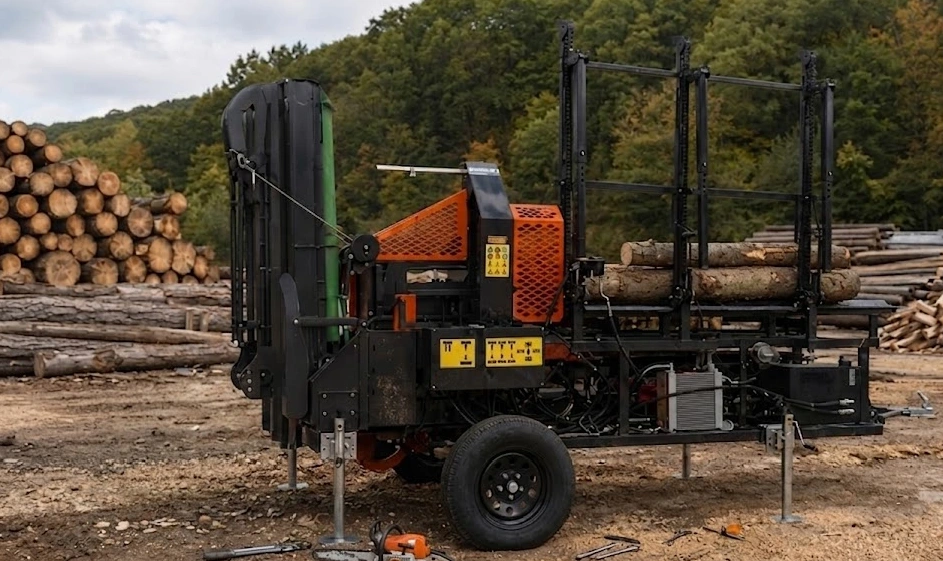
In a firewood yard, splitting force gets a lot of attention. Fair enough. But after a few hours of real work, most operators care just as much about feeding. If logs keep twisting, stopping, or backing up near the saw, a powerful machine still feels slow.
A Portable Commercial Wood Processor needs to do more than split hard wood. It should handle uneven logs, hold them steady, cut cleanly, split without crowding the chamber, and move finished firewood away before the next piece arrives.
RIMA builds farm and forestry machinery for practical yard work, including firewood processors, sawmills, wood chippers, tree cutting machines, and stump grinders. The RM500 PLUS-ECO(N/A) is designed for commercial firewood production with chain feeding, a fixed log table, hydraulic clamping, a Honda GX630 gasoline engine, and a layout that suits mobile jobs as well as fixed firewood yards.
Why Do Feed Jams Start on a Live Deck?
Feed jams often begin before cutting starts, when crooked logs, rushed loading, and poor alignment disturb the whole processing rhythm.
Crooked Logs Create Side Pressure
A live deck can save labor, but it does not make bad logs disappear. Most feed jams begin before the saw bar touches the wood.
Crooked stems, forked sections, wide butt ends, and rough bark can all make a log enter the feed path at the wrong angle. Once the log twists sideways, the feed chain has to pull against shape resistance instead of simply carrying the log forward. That is when operators start stopping the machine, resetting the log, or pulling material back by hand.
Rushed Loading Breaks the Feed Rhythm
Log placement also matters. If workers load the first layer too quickly, one log may press against another and create side pressure. The machine may still have enough power to move it, but the feed rhythm becomes uneven.
Feeding too fast can cause the same issue. The next section should not move forward before the saw has cut cleanly, the clamp has released, the wedge has returned, and split wood has started moving toward the conveyor. The RM500 PLUS-ECO(N/A) has an 11-second cycle time, so the best output usually comes from matching the machine’s rhythm instead of forcing every log through as fast as possible.
How Does the RM500 PLUS-ECO(N/A) Help Logs Move Better?
Better log movement comes from stable feeding, firm control, enough engine power, and a frame built for real work sites.
Fixed Table and Chain Feeding Keep Logs Aligned
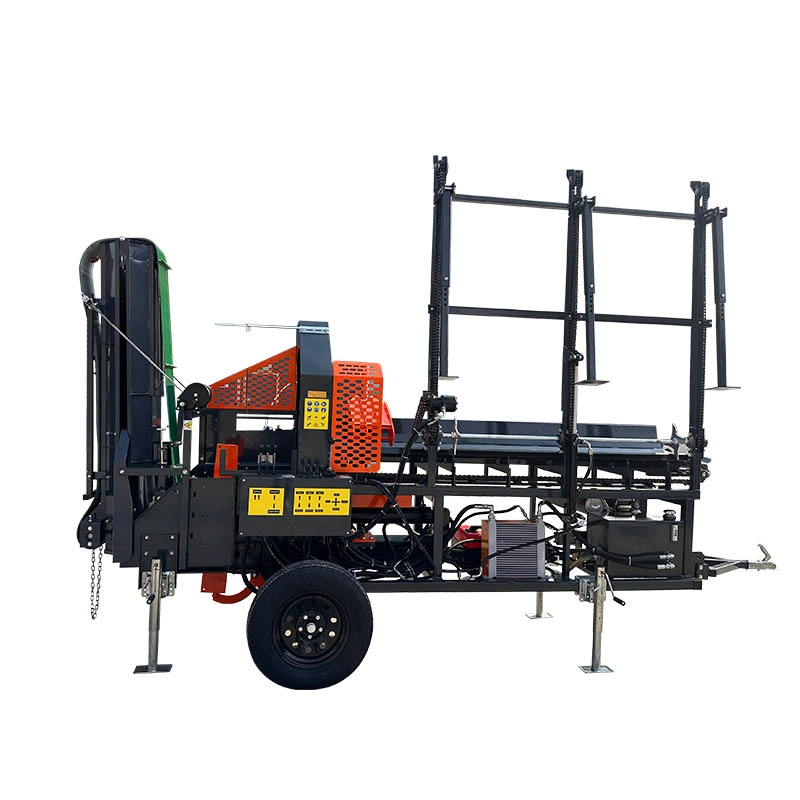
The RM500 PLUS-ECO(N/A) is built around a more controlled feed path. Its log table is bolted firmly to the processor, which helps keep the feed direction stable during work. This matters on farms, forest yards, and temporary cutting sites where the ground may not be perfectly flat.
A loose or poorly aligned table can make the whole machine feel harder to run. Logs may enter slightly off line, and the operator may not notice the problem until jams keep happening near the saw or clamp. A fixed log table reduces that risk and makes setup more predictable after transport.
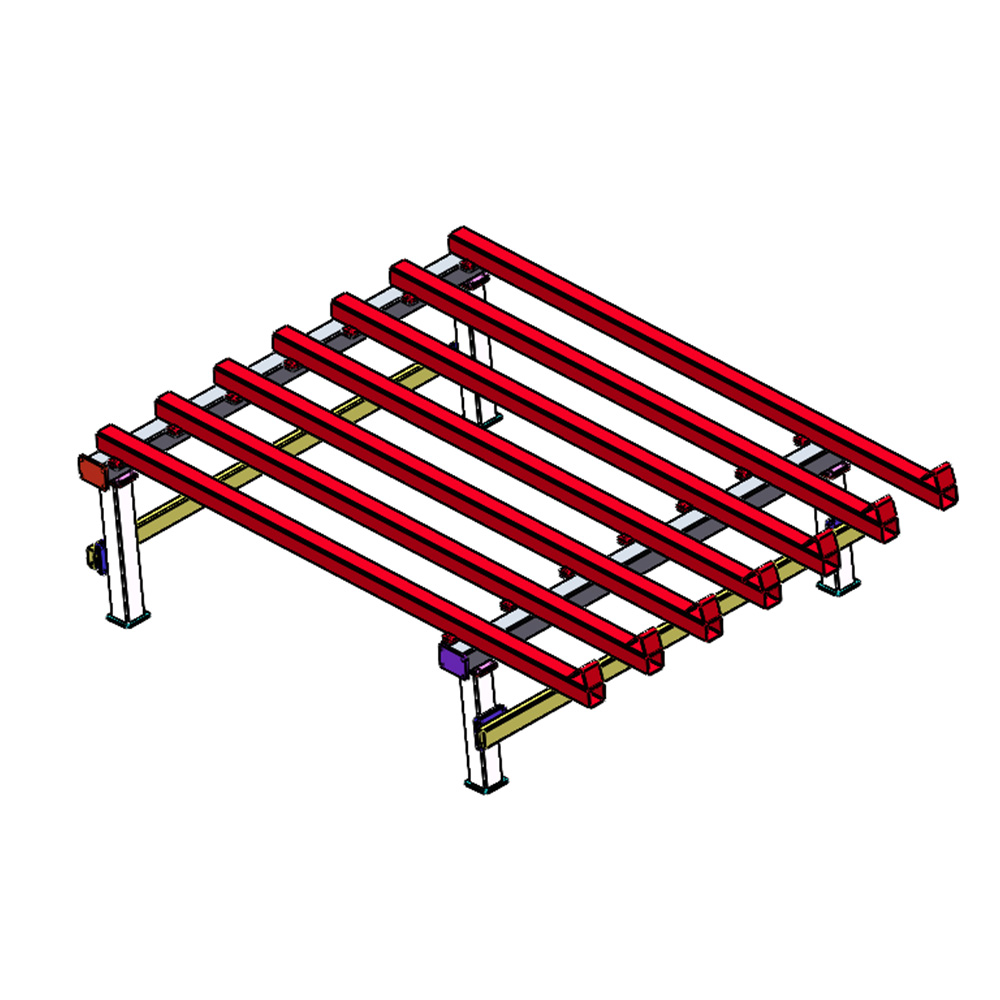
The hydraulic chain feeding platform is another key part of the design. The machine uses a 2730 x 400 mm hydraulic chain feeding platform with three table chains. Instead of relying on workers to push or roll heavy logs by hand, the chain system pulls logs forward in a more controlled direction. This reduces sudden sliding and helps the saw receive the log in a cleaner position.
Honda GX630 Power Supports Steady Processing
The engine also deserves more attention here. The RM500 PLUS-ECO(N/A) uses the Honda GX630 as its standard engine. The Honda GX630 20HP is a premium 688cc, air-cooled 4-stroke OHV V-Twin commercial engine. Honda V-twin engines offer high horsepower, great adaptability, quiet operation, and excellent fuel efficiency. Delivering 20.8 horsepower (15.5 kW) at 3,600 RPM, it is widely used in high-demand industrial equipment.
For a firewood processor, this matters because stable engine output supports the hydraulic system, saw performance, and repeated operating cycles. Feed jams are not only about the deck. They are also about whether the machine can keep cutting, clamping, splitting, and conveying without feeling weak under mixed timber.
Log Lift and Axle Design Improve Real-Site Use
For heavier timber, the optional log lift can improve feeding. It helps raise logs and guide them toward the feed opening with less manual handling. That means less rushed loading, fewer dropped logs, and less twisting on the deck.
The upgraded heavy-duty torsion-damping axle also supports real yard use. A portable machine often travels across uneven ground, gravel roads, farms, and job sites. A stronger torsion-damping axle helps the processor handle transport and rougher working conditions with better stability, which is important for buyers who move equipment between locations.
Which Machine Features Reduce Feed Jams?
A strong feed system works best when the clamp, wedge, saw, and conveyor all support smooth material flow.
Four-Way Hydraulic Clamp Holds Logs Before Cutting
Several RM500 PLUS-ECO(N/A) features work together to reduce feed problems.
The four-way adjustable hydraulic clamp is one of the most important. A log that moves during cutting can pinch the saw bar, roll into the splitting chamber, or leave an uneven cut. The hydraulic clamp comes with four-way adjustment and a safety valve in the ram, helping it hold the log with a stronger, safer grab. Once the log is held firmly, the saw cut is cleaner and the following split is less likely to jam.
Lower-Mounted Wedge and Conveyor Keep the Chamber Clear
The lower-mounted hydraulic wedge also helps. Because the wedge is positioned lower, it reduces the chance of logs hitting the hydraulic push rod during operation. This keeps the splitting path clearer and lowers the chance of awkward blockages around the wedge area.
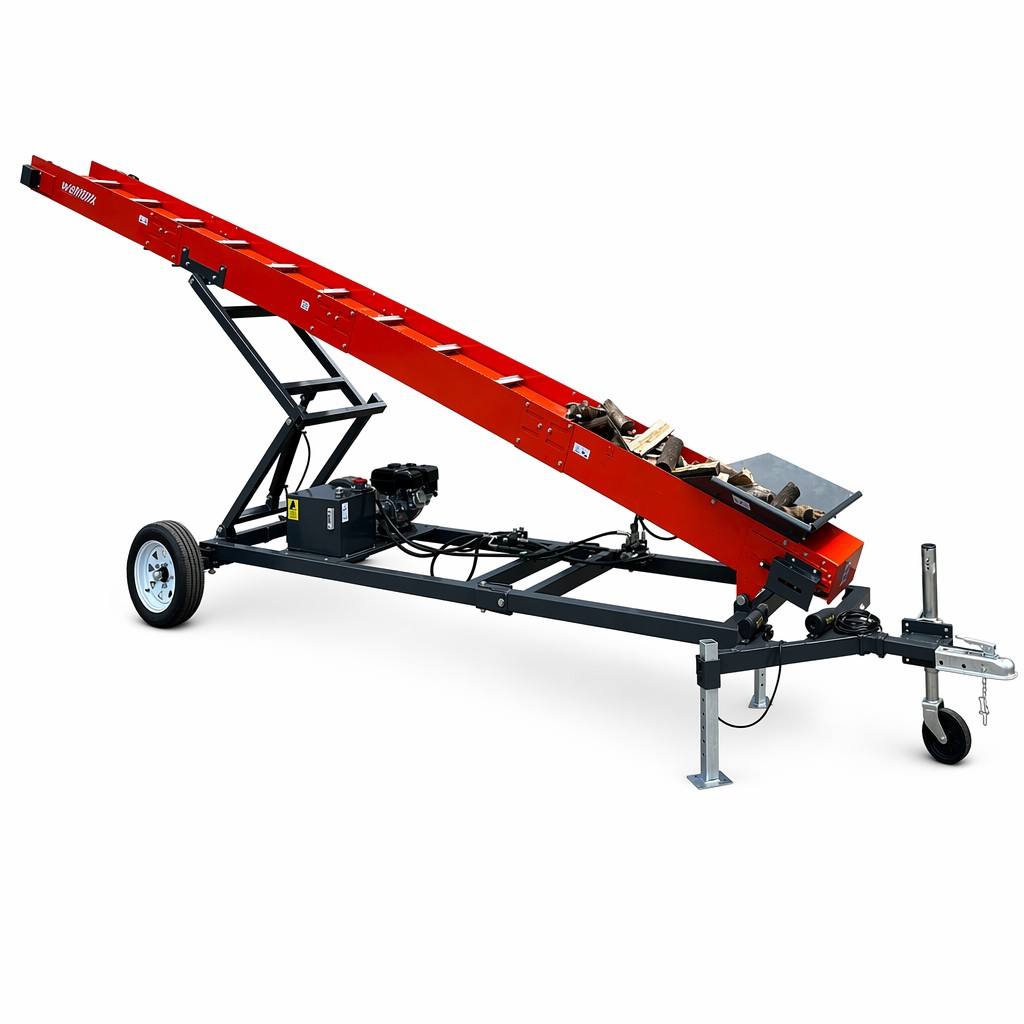
After splitting, the standard 3.2 m firewood conveyor with a 250 mm belt moves finished firewood away from the working area. This prevents cut pieces from crowding the chamber while the next log is already being fed.
RM500 PLUS-ECO(N/A) Key Specifications and Practical Value
Specifications matter when they explain daily work: power, feeding control, hydraulic stability, mobility, and output consistency.
Core Power and Cutting Data
| Item | RM500 PLUS-ECO(N/A) Data | Why It Matters |
| Standard engine | Honda GX630 20HP gasoline engine, 688cc air-cooled 4-stroke OHV V-Twin, electric start | Delivers reliable V-Twin commercial power for repeated cutting, splitting, and hydraulic operation |
| Max splitting force | 45 tons | Handles dense hardwood with fewer repeat splits |
| Max log diameter | 500 mm | Fits many commercial firewood jobs |
| Max log length | 500 mm | Supports common firewood cutting sizes |
| Work efficiency | 8 m³/h | Gives buyers a clear output reference |
| Cycle time | 11 seconds | Helps operators build a steady feed-cut-split rhythm |
| Oil tank | 50 L | Seperate bigger oil tank ,makes good heat dissipation |
Feeding, Hydraulic, and Mobility Data
| Item | RM500 PLUS-ECO(N/A) Data | Why It Matters |
| Hydraulic chain feeding | 2730 x 400 mm, 3 table chains | Guides logs forward with better control |
| Hydraulic clamp | Four-way adjustment, safety valve in ram | Gives a powerful grab and reduces rolling during cutting |
| Saw system | 24-inch harvester saw bar, .404 saw chain | Suits heavy cutting work |
| Knife | 6-way splitting knife | Improves splitting output for suitable log sizes |
| Conveyor | 3.2 m length, 250 mm belt width | Moves split wood away from the chamber |
| Hydraulic system | 48 L/min two-stage pump, 20 MPa pressure | Supports stable feeding, clamping, and splitting |
| Axle | Upgraded heavy-duty torsion-damping axle | Helps with transport and rough-site mobility |
| Wheels and traction | 2 × 205/75R15 tires, 50 mm traction ball | Better fit for mobile firewood processing work |
What Operator Habits Keep the Feed Path Clear?
Even a capable wood processor works better when operators sort bad logs, watch the full flow, and clear debris early.
Sort Problem Logs Before They Reach the Saw
A strong processor still needs sensible operation. The fastest crew is usually not the one forcing every bad log through the machine. It is the crew that keeps the feed path clean and steady.
Bad logs should be handled before they reach the saw. Very crooked, muddy, forked, or oversized logs may slow the whole line. Trimming them first can be faster than fighting them inside the processor.
Watch the Full Material Flow
Operators should also watch the full material flow. Do not only look at the log entering the saw. Check whether the clamp releases cleanly, whether the wedge returns, whether split wood clears the conveyor, and whether bark is building up near the table chain.
Daily checks are simple but important. A dull saw chain cuts slowly and can pull unevenly. Low or dirty hydraulic oil can make the clamp, feed chain, or wedge respond less smoothly. Bark, chips, mud, and small offcuts should be cleared during breaks instead of waiting until the end of the day.
Why Choose RIMA for a Portable Commercial Wood Processor?
The right processor should fit the yard’s real workflow, not just look powerful on a specification sheet.
RIMA Focuses on Practical Forestry Machinery
Choosing a wood processor is not just about buying the highest splitting force. It is about matching the machine to how the yard really works: log size, crew size, loading method, transport needs, firewood length, and daily output.
RIMA focuses on farm and forestry equipment and provides one-stop solutions for global customers. Its product range covers firewood processors, sawmills, wood chippers, tree cutting machines, stump grinders, and related machinery. The company also supports OEM and ODM services for customers in Europe and North America, with product upgrades based on user feedback.
RM500 PLUS-ECO(N/A) Fits Commercial Firewood Work
For buyers comparing portable commercial wood processors, the RM500 PLUS-ECO(N/A) has several practical strengths. It combines a Honda GX630 commercial V-Twin engine, 45 tons of splitting force, chain feeding, hydraulic clamping, a lower-mounted wedge, standard conveyor, hydraulic oil cooling, highway trailer tires, and an upgraded heavy-duty torsion-damping axle.
That mix is important. The machine is not only built to split tough logs. It is built to keep logs moving, hold them securely, reduce chamber crowding, and support mobile firewood production with fewer small interruptions through the workday.
FAQs
Q: What Causes Feed Jams on a Portable Commercial Wood Processor with a Live Deck?
A: Most feed jams come from crooked logs, poor deck loading, rushed feeding, dull saw parts, weak clamping, or debris around the chain feed and conveyor.
Q: Why Is the Honda GX630 Important on the RM500 PLUS-ECO(N/A)?
A: The Honda GX630 gives the machine a commercial V-Twin power source with strong output, quieter operation, good fuel efficiency, and wide use in demanding industrial equipment.
Q: Is the RM500 PLUS-ECO(N/A) Suitable for Commercial Firewood Production?
A: Yes. It has 45 tons of splitting force, 500 mm maximum log diameter, 8 m³/h work efficiency, hydraulic chain feeding, four-way hydraulic clamping, and a 3.2 m conveyor.





LEAVE A REPLY